
DMC software: what a destination management company actually needs (and what to ask in a demo)
A DMC quotes many groups, buys net from dozens of local suppliers and sells through agents. Here is what your software has to handle, a worked group quote, and the questions to ask every vendor.
Key takeaways
- DMC software is judged on the whole loop: net costs in, a group price ladder out, a B2B proposal sent, suppliers booked and deposits collected.
- Separate fixed costs (coach, guide) from per-person costs (rooms, meals, tickets) — that split is what makes a price ladder by group size correct.
- Quoting agents in GBP or USD while your suppliers bill in EUR is a currency risk; your tool should let you set and edit the exchange rate deliberately.
- Test every vendor with one of your own real group programmes, not their demo data.
A destination management company does not sell trips the way a travel agency does. You buy net from hotels, coach companies, guides, restaurants and venues in your own country, build a programme, and sell it — usually to a tour operator or travel agent abroad who sells it on to their clients. You quote far more groups than you confirm, every quote has dozens of lines, and once a group says yes the real work of booking and reconfirming begins.
That is why generic “itinerary software” often disappoints DMCs. A beautiful client document is the easy part. This guide sets out what DMC software actually has to do, works through a real-shaped group quote with the arithmetic, and ends with an evaluation checklist and the questions worth asking in every demo. We run inbound tour companies in the Baltics ourselves, so the examples come from Lithuania, Latvia and Estonia — but the logic is the same in any destination.
Why DMC work needs different software
Most travel software is built around one of two buyers: the advisor who books other companies’ products for commission, or the operator who sells departures direct to the public. A DMC sits in between, and its day looks different:
- B2B first. Your client is often a tour operator, a travel agency or an incentive planner. They want a clear net or gross price per person, a programme they can rebrand or forward, and fast answers.
- Groups and group sizes. The same five-day programme might be quoted for 15, 25 and 40 travellers in one email, and the per-person price is different for each.
- Many local suppliers. A single programme can involve two or three hotels, a coach company, several guides, restaurants, museums and an activity provider — each with its own rates, seasons and terms.
- Low conversion, high volume. Agents send the same request to several DMCs. You may quote many groups for every one that confirms, so quoting speed matters as much as accuracy.
- Operations after the sale. Rooming lists, supplier confirmations, deposits to hotels, final numbers and reconfirmations all happen weeks or months after the quote.
If you are comparing tools in general rather than for a DMC, our itinerary builder software comparison covers nine products by business type. This guide goes deeper on the DMC-specific requirements.
What DMC software has to do
Here are the jobs, roughly in the order a group moves through your business. A tool does not need to be best at all of them, but you should know which ones it handles and which stay in email and spreadsheets.
1. Cost a programme from many suppliers
You need a library of your own suppliers and services — hotels, transfers, guides, meals, entrances — with net rates and descriptions, so a new quote is assembled rather than retyped. Each line must know whether it is priced per person, per room or as a flat amount for the whole group.
2. Price by group size and season
Hotels and venues often have seasonal rates and group rates, and coaches and guides cost the same whether 15 or 30 people travel. Good DMC software makes it easy to change the number of travellers and see the per-person price move correctly — and, ideally, to produce a ladder of prices for several group sizes.
3. Apply markup or margin consistently
A 25% markup is a 20% margin, and confusing the two is one of the most expensive mistakes in group pricing. Your tool should let you choose one at trip level, override it on individual services, and always show the profit you are actually making. Our markup vs margin guide has the formulas and a conversion table.
4. Send B2B proposals and options
Agents want a clean programme they can forward, sometimes with prices hidden. They also often ask for alternatives — a four-star and a three-star version, or with and without a day trip. Sending Option A and Option B side by side saves a round of emails.
5. Handle more than one currency
A Baltic DMC buys almost everything in euros but may sell to UK operators in pounds and US agencies in dollars. The tool must convert at a rate you control, not a rate it fetched silently.
6. Track supplier bookings to confirmation
Once a group confirms, every service needs to be requested, booked and confirmed, with references and due dates. A clear status per service — not a colour-coded spreadsheet — is what stops the “did anyone book the dinner in Riga?” moments.
7. Collect deposits and balances
Groups usually pay a deposit at confirmation and a balance before arrival. You need invoices with a payment schedule and an easy way for the client to pay. Our guide to deposits and payment schedules covers typical terms.
8. Run the pipeline and the team
A pipeline of open requests, contacts at each partner agency, and follow-up tasks keep quotes from going cold. And because sales and operations are often different people, roles matter: the person booking suppliers does not need to see every deal value, and a new salesperson should not be able to change the company’s settings.
A worked group quote: 5 days in Vilnius and Riga
Here is a typical inbound programme for a group of 20, four nights split between Vilnius and Riga, with a coach and driver throughout, a guide on three days, two group dinners and two entrance tickets. The rates are illustrative, not a price list — but the structure is exactly what a DMC prices every week.
| Service | Basis | Calculation | Net cost (EUR) |
|---|---|---|---|
| Hotel, Vilnius, 2 nights | Per room | 10 twins × 2 × €110 | 2,200 |
| Hotel, Riga, 2 nights | Per room | 10 twins × 2 × €120 | 2,400 |
| Coach with driver, 5 days | Flat | 5 × €630 | 3,150 |
| English-speaking guide, 3 days | Flat | 3 × €220 | 660 |
| Entrance tickets (2 sites) | Per person | 20 × €27 | 540 |
| Group dinners ×2 | Per person | 20 × 2 × €35 | 1,400 |
| Total net cost | 10,350 |
Net cost per person is 10,350 ÷ 20 = €517.50. With a 20% margin target:
That is €646.88 per person and a profit of €2,587.50. The same price comes from a 25% markup (10,350 × 1.25 = 12,937.50) — which is why you must know which one you mean.
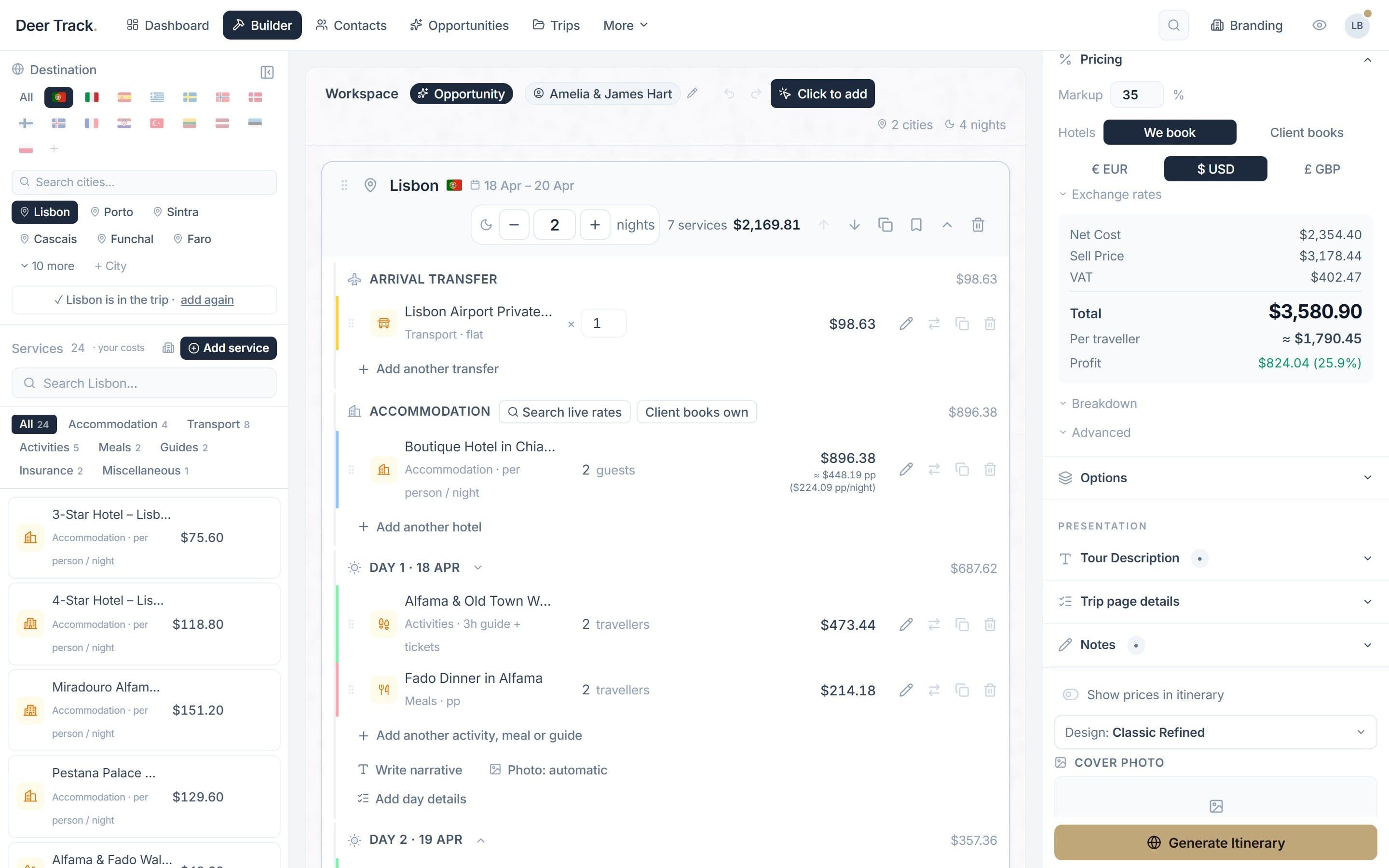
The price ladder: why per person changes with group size
Split the costs into two kinds. Fixed costs are the same however many people travel: coach €3,150 + guide €660 = €3,810. Variable costs scale with each traveller: hotel €230 (twin share), tickets €27 and dinners €70 = €327 per person.
| Paying travellers | Fixed share pp | Variable pp | Net pp | Sell pp (20% margin) |
|---|---|---|---|---|
| 15 | €254.00 | €327.00 | €581.00 | €726.25 |
| 20 | €190.50 | €327.00 | €517.50 | €646.88 |
| 25 | €152.40 | €327.00 | €479.40 | €599.25 |
Agents expect a ladder like this, often with a line saying the price is valid for a minimum number of paying travellers. Two checks before you send it: does the coach size still work at the top of the range, and do the hotels have enough rooms at the group rate? If the group grows past one coach, the fixed cost jumps and the ladder needs a new row.
Adding a free place for the tour leader
Many group contracts include one free-of-charge (FOC) place for the tour leader, commonly per 20 or so paying travellers. Say the leader has a single room (€95 × 2 in Vilnius + €105 × 2 in Riga = €400), plus tickets €27 and dinners €70: €497.
Spread over 20 paying travellers that is €24.85 each, so net per person rises to €517.50 + €24.85 = €542.35, and the selling price at a 20% margin becomes 542.35 ÷ 0.80 = €677.94. Forget the FOC and you give away €497 — almost a fifth of the €2,587.50 profit.
Want to try your own numbers first? The free tour price calculator handles per-person and flat items together and converts markup to margin.
Quoting agents in GBP or USD when suppliers bill in EUR
Suppose the agent for the group above is in the UK and wants a sterling price. At an illustrative rate of 1 EUR = 0.85 GBP, €646.88 becomes £549.85 per person.
Now the pound weakens before the balance is paid and 1 EUR costs 0.88 GBP. The agent still pays £549.85, which is now only 549.85 ÷ 0.88 = €624.83. You have lost €22.05 per person — €441 on the group — out of a planned profit of €129.38 per person, without any supplier changing a price.
Common ways DMCs manage this:
- Set the rate deliberatelyrather than using whatever the day’s rate happens to be, and build in a small buffer you decide on.
- State the rate and its validity in the quote, with the right to adjust if it moves beyond an agreed band.
- Quote in EUR where the partner accepts it, and let them carry the conversion.
Whatever your policy, the software should show which rate a quote used and let you edit it, so two salespeople do not quote the same programme at two different rates.
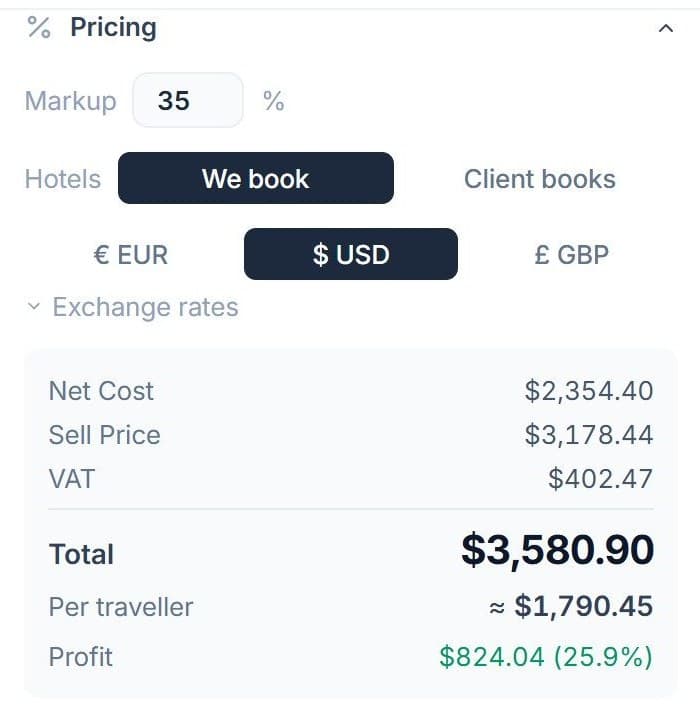
From proposal to confirmed suppliers
The quote is where DMC software earns its keep on the sales side; the weeks after confirmation are where it earns it on the operations side. Two things are worth looking at closely in any tool.
The B2B proposal
Your partner agency usually wants a day-by-day programme, the hotels, what is included and excluded, and the price ladder. Some want it with prices; some want it without, to add their own. Check that you can hide prices, send two options side by side, and update the programme after the agent’s feedback without rebuilding it.
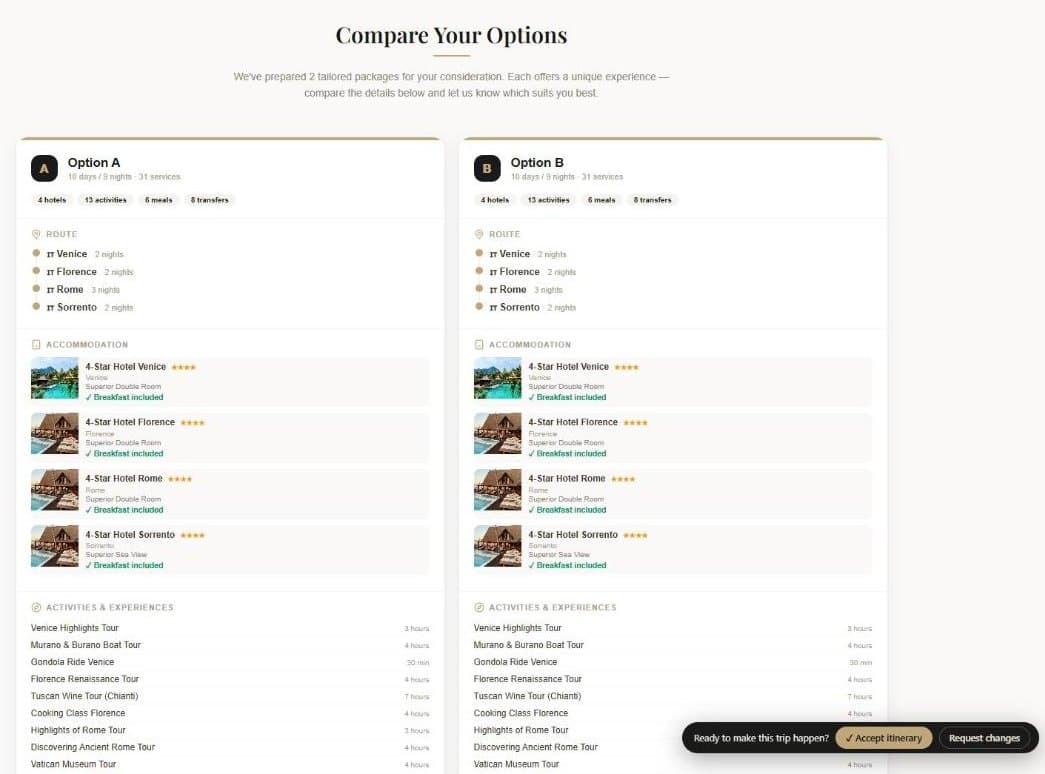
Supplier bookings
Once confirmed, every line in the programme becomes a booking to make: rooms on a group contract, the coach, each guide day, each dinner. Look for a per-service status (requested, booked, confirmed), the supplier and booking reference on each line, a due date, and who is responsible. Ideally, the booking list is created from the confirmed quote, not retyped from it.
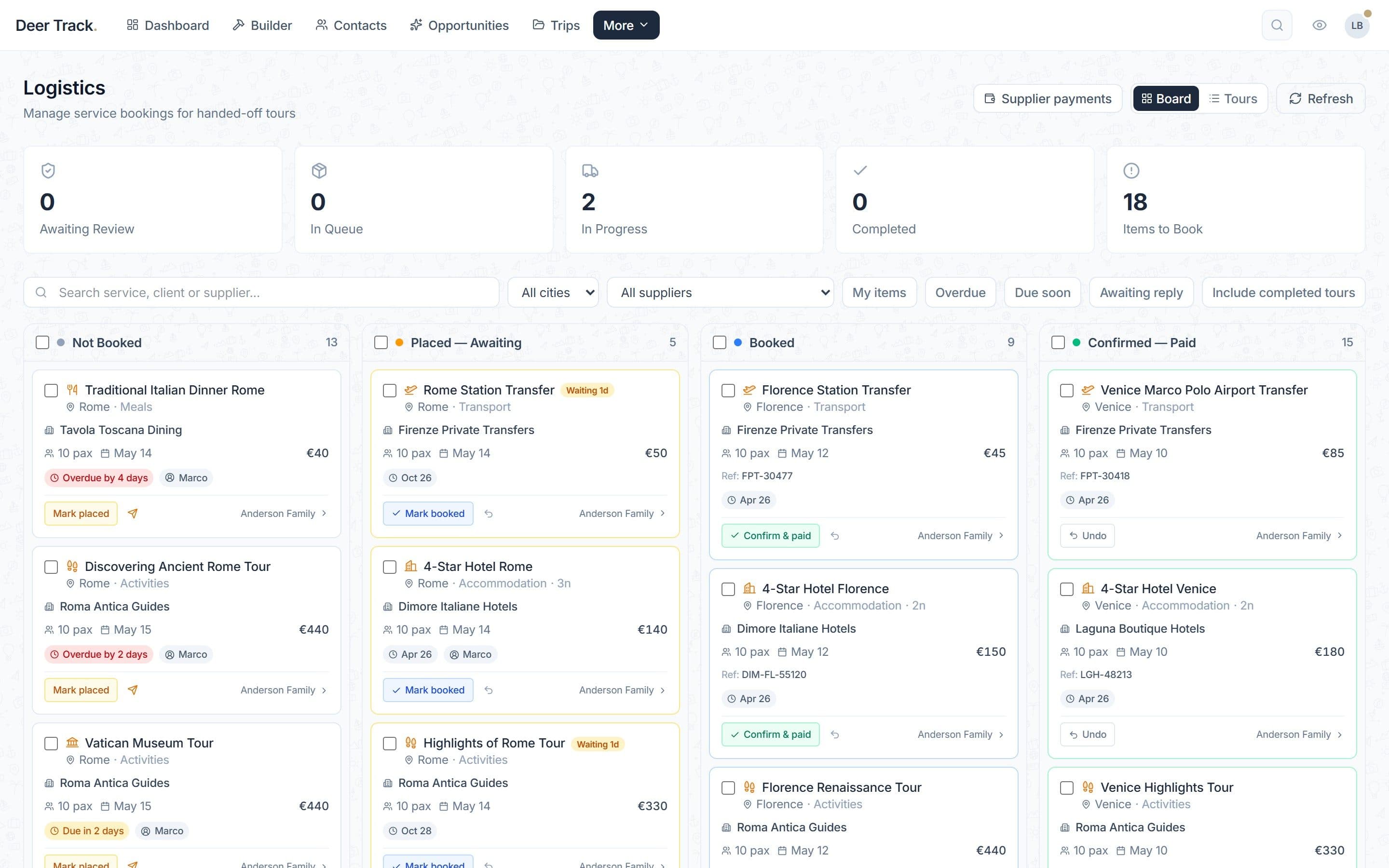
Deposits and balances
A common pattern is a deposit at confirmation and the balance several weeks before arrival, timed so you hold the money before hotels and other suppliers need paying. On the group above, rounded to €647 per person for the quote, the total is €12,940: a 30% deposit of €3,882 and a balance of €9,058. Your software should produce that schedule on the invoice and show what is still due.
DMC software evaluation checklist
Score each shortlisted tool against these with one of your own recent group programmes:
- Supplier and service library — your hotels, guides, coaches and venues with net rates and reusable descriptions.
- Per person, per room and flat costs in the same quote, with group size driving the per-person lines.
- Price ladders — how quickly can you re-price for 15, 20 and 25 travellers?
- Seasonal and negotiated rates — where do they live, and how do you override a rate for one group?
- Markup or margin at trip level, with per-service overrides and a visible profit line.
- Currencies — EUR, GBP, USD (or yours), with an exchange rate you can see and edit.
- VAThandled per service, in line with your accountant’s advice.
- B2B proposals — branded, with or without prices, as a web link and PDF, with Option A/B.
- Supplier booking workflow — status, supplier, reference and due date for every service.
- Invoices with deposits and a payment link, and clarity on who charges a fee per transaction.
- Pipeline and contacts for partner agencies and their staff.
- Team roles that separate sales from operations.
- Data import and migration help for your supplier list and contacts.
What to ask vendors in a demo
Demos are designed to look effortless. These questions make them closer to a real working day:
“Can we build one of our groups, live?”
Bring a recent programme with mixed per-person and flat costs, two hotels and a FOC place. Watch how long it takes and how many workarounds appear.
“Show me the price for 15, 20 and 25.”
Changing group size should re-price the per-person lines and leave fixed costs alone. Check the per-person result by hand.
“Is this markup or margin, and where do I see profit?”
Ask them to set a 20% margin and confirm the price equals cost ÷ 0.80, not cost × 1.20.
“Quote this in GBP. Which rate did you use?”
You want to see the exchange rate, change it, and know it is stored with the quote.
“The group confirmed. What happens next?”
Follow the trip from quote to supplier requests, booking references and confirmations — and to the deposit invoice.
“What will we still do outside the system?”
Every tool has edges. A vendor who answers this plainly is one you can work with.
“What does it cost for our team, and what is the setup?”
Seats, transaction fees, implementation time and who moves your existing data.
A lighter tool or a full reservations system?
DMC software comes in two broad shapes, and the right one depends on your size more than your ambitions.
Lighter quoting and operations tool
- Set up in days to weeks
- Builder, pricing, proposals, payments and light CRM together
- Suits small-to-mid DMCs and tailor-made teams
- Contracting and accounting stay in your existing tools
Enterprise reservations system
- Implementation project, often months
- Contracting, inventory, accounting and distribution in one database
- Suits high-volume DMCs with dedicated system owners
- More power, more setup and training
Deer Track is in the first group, and it is worth being clear about what it does not do:
- No air or GDS booking. It does not book flights; if your programmes include air, you price it in as a service.
- Seasons are by month, not by date range. A service can carry seasonal prices for month ranges (and hotels have rates by room type), and guide, ticket or transport costs can be priced by group size — but there is no contract-management module with date-range validity, allotments or release tracking.
- Hotel rates via RateHawk are in beta. You can connect a RateHawk B2B account to search live hotel rates from a trip; live booking is switched on per account.
- Not an accounting system.Invoices and payments are for collecting from clients; your books stay with your accountant’s tools.
- No mobile app yet, and no self-serve free trial — every plan starts with a guided demo.
Frequently asked questions
What is DMC software?
DMC software is the system a destination management company uses to cost programmes from local supplier rates, quote groups to agents and tour operators, book and confirm suppliers, and collect payments. It ranges from lighter quoting tools to full reservations systems.
What should a DMC look for in itinerary software?
Look for a supplier and service library, pricing from net rates with markup or margin control, per-person and flat costs driven by group size, multiple currencies with editable exchange rates, B2B proposals with options, supplier booking tracking and invoices with deposits.
How do you price a group tour by group size?
Split costs into fixed costs such as coach and guide, which are shared across the group, and variable per-person costs such as rooms, meals and tickets. Net per person is fixed costs divided by paying travellers plus variable costs, then apply your markup or margin.
Is a DMC booking system the same as a reservations system?
Not always. Some DMC tools focus on quoting, proposals and supplier booking status, while enterprise reservations systems also handle contracting, inventory, accounting and distribution. Small and mid-sized DMCs often do not need the full reservations scope.
Should a DMC quote agents in their currency?
It can, but it takes on currency risk when suppliers are paid in another currency. Set the exchange rate deliberately, state it and its validity in the quote, or quote in your own currency where the partner accepts it.