
Supplier booking management for tour operators: from “booked” to every service confirmed
The client said yes. Now every hotel, guide, coach, restaurant and ticket has to be requested, confirmed, paid and reconfirmed. Here is a workflow that keeps nothing slipping.
Key takeaways
- Treat every service in a trip as its own line with one status, one owner, one due date and one supplier reference.
- A booking is not done when you send the request — only a written confirmation with a reference number counts.
- Work backwards from option dates, release dates and payment deadlines, and put each one in the diary the day you learn it.
- Reconfirm every service shortly before arrival, because suppliers change too.
- A clean handover from sales to operations prevents most booking errors before they happen.
The moment a client accepts a proposal feels like the finish line. For operations it is the start. A single eight-day group trip can mean a dozen or more separate suppliers — hotels, coaches, guides, restaurants, museums, boat operators — each with its own booking process, its own deadlines and its own way of saying “yes”.
Supplier booking management is the discipline of taking every one of those services from “not yet requested” to “confirmed, paid and reconfirmed”, with a paper trail. This guide covers the handover from sales, the status workflow, what a good booking request contains, option and release dates, rooming lists, chasing, payments, changes and cancellations, and a pre-departure checklist — with a worked example of a 14-line group trip.
Start with a clean handover from sales
Most booking mistakes are made before anyone emails a supplier. The salesperson knows the client wants a sea-view room, that one traveller uses a wheelchair, and that the Tuesday dinner was promised as a private room. If that knowledge stays in their head or their inbox, operations books the wrong thing correctly.
Make the handover a defined step, not a forwarded email. Before a trip moves to operations, it should carry:
- The final, accepted itinerary — the version the client agreed to, not an earlier draft. Dates, cities, nights, every service.
- Final passenger numbers and room split, even if names come later.
- The costed price with the net rate assumed for each supplier, so operations can spot a rate that has moved.
- Promises made in writing: room types, upgrades, dietary needs, accessibility, special occasions, guide language.
- Payment status: has the client deposit arrived? Many operators do not commit supplier money until it has — see our guide to deposits and payment schedules.
Then let operations accept or rejectthe handover. A quick review — do the nights add up, is every day covered, does the transfer match the flight time — catches errors while they are still cheap. If something is wrong, it goes back to sales with a reason, not a vague “can you check this?”.
One line per service, one status per line
The core idea is simple: break the trip into supplier lines and give each line exactly one status. “Riga is mostly done” is not a status. “Riga hotel: confirmed, ref 48213, deposit paid; Riga guide: requested 3 days ago, no reply” is.
The exact labels matter less than using them consistently. A workable set looks like this:
| Status | What it means | What moves it on |
|---|---|---|
| Not booked | The service is in the itinerary but nobody has contacted the supplier. | Sending a booking request. |
| Requested / placed | The request has gone out. You are waiting for availability and a rate. | A written reply — yes, no, or an alternative. |
| On option | The supplier is holding space until a stated date, unconfirmed. | Confirming before the option expires, or releasing it. |
| Booked | The supplier has accepted the booking, but terms are not yet complete (names, deposit, final numbers). | Sending what the supplier needs and receiving their confirmation. |
| Confirmed | Written confirmation with a reference number, dates, numbers and the agreed rate. | Paying per the supplier’s terms. |
| Paid | Deposit or full payment sent as agreed, and recorded against the line. | Reconfirmation shortly before arrival. |
| Cancelled | Released or cancelled in writing, with any charges noted. | — |
Each line also needs an owner (who is handling it), a due date (the next deadline that matters — an option expiry, a payment, a rooming list) and a supplier referenceonce you have one. With those four fields filled on every line, you can answer “what is outstanding on this trip?” in seconds instead of reading three email threads.
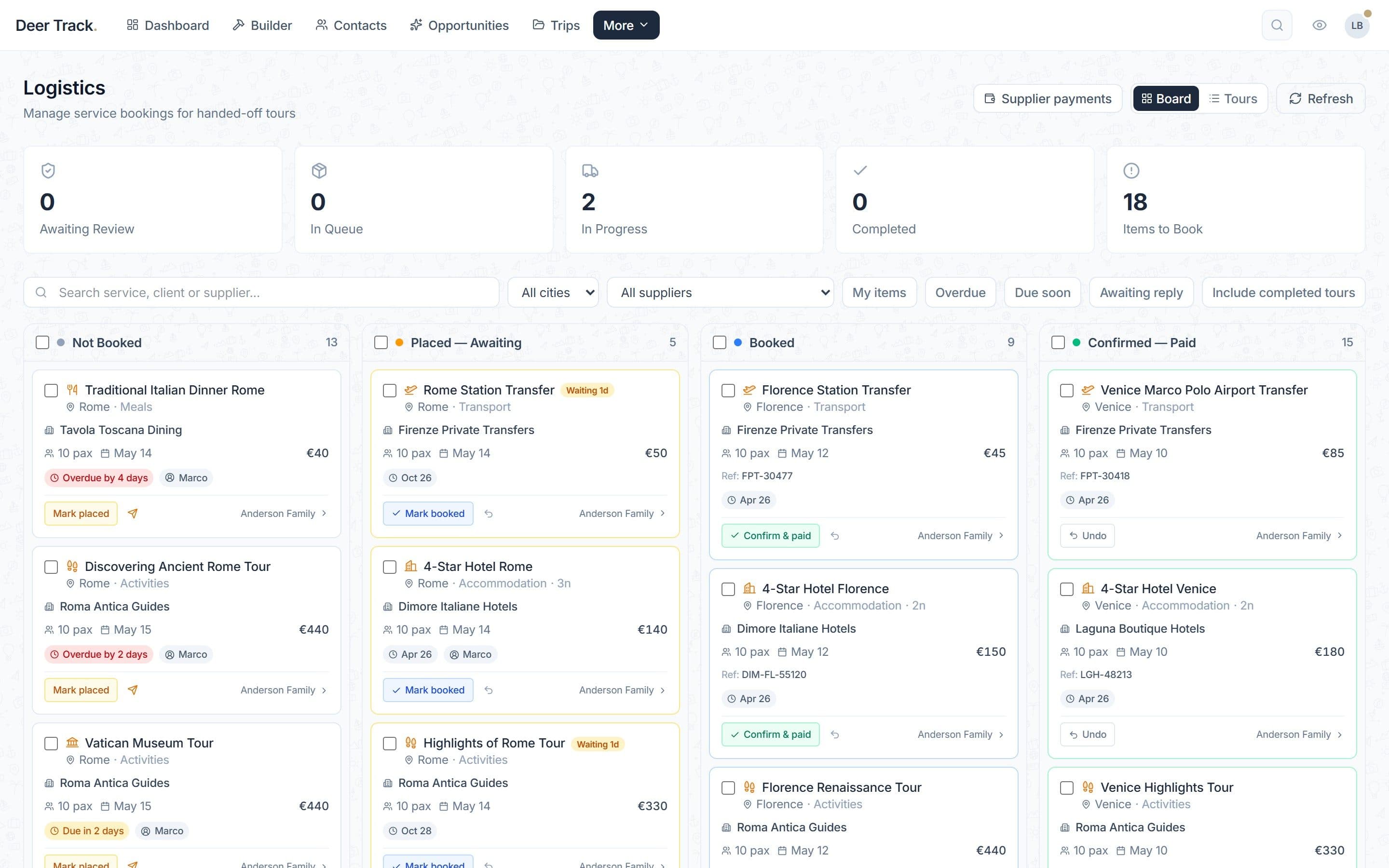
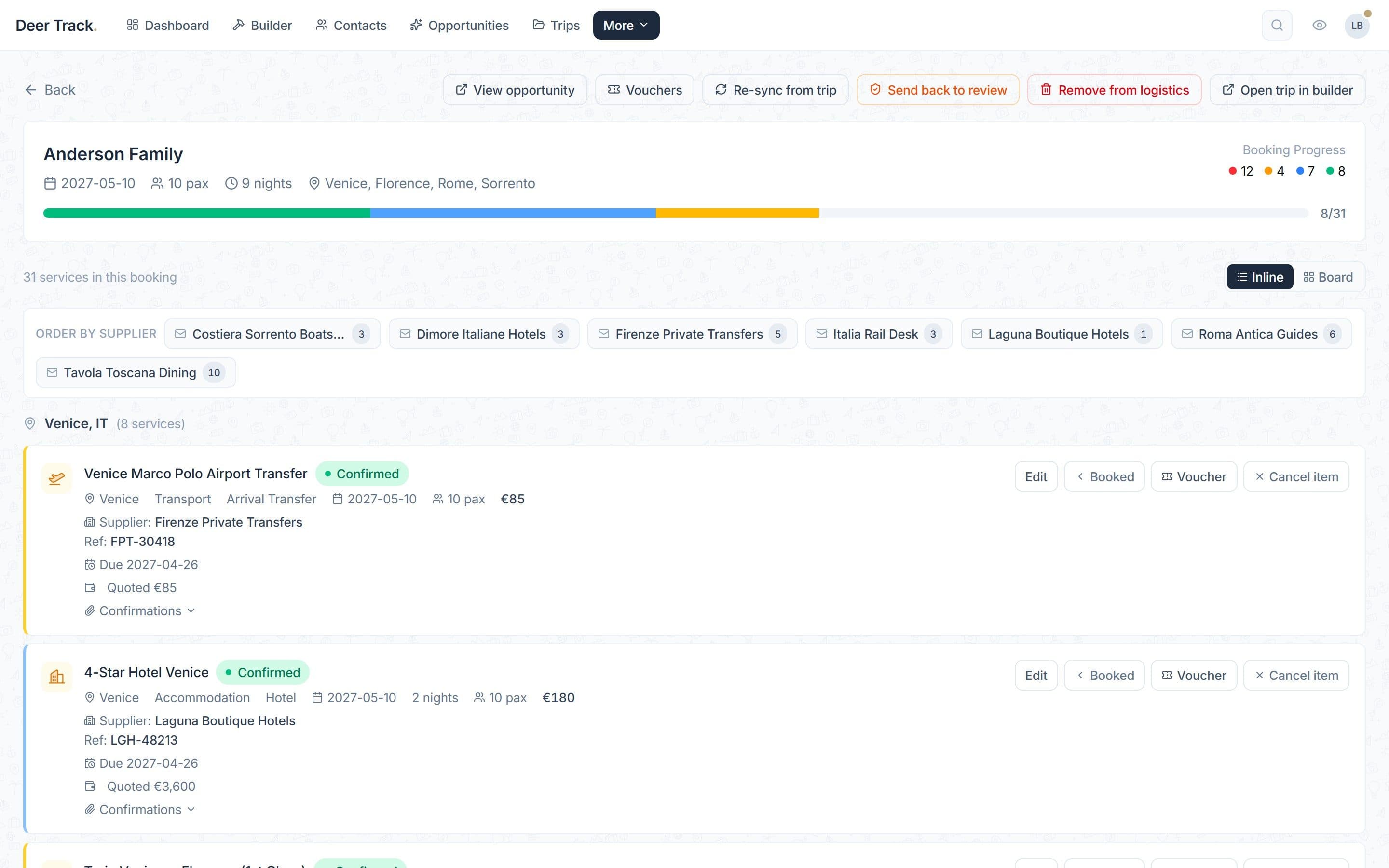
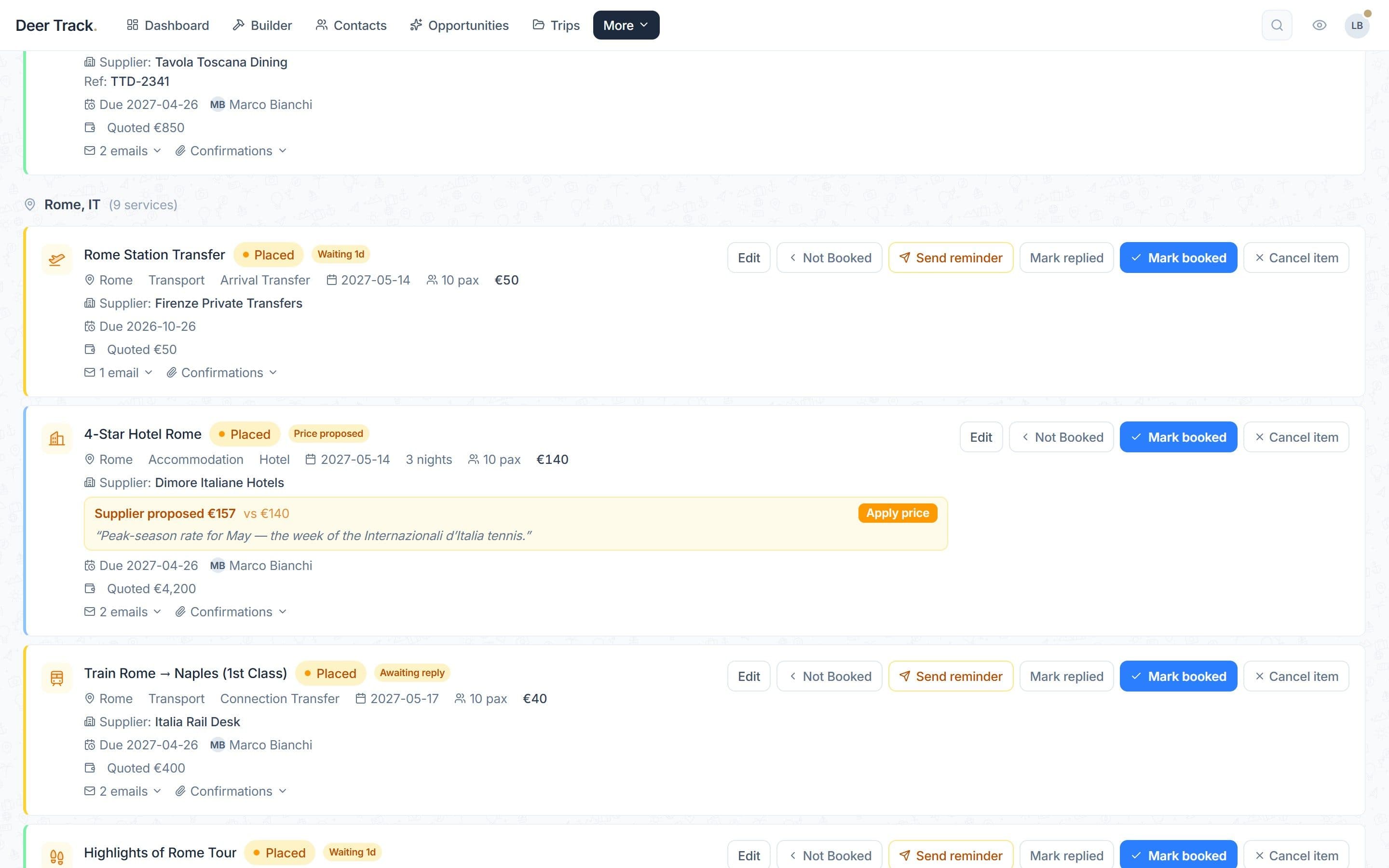
01Every supplier booking on one board
Not Booked → Placed — Awaiting → Booked → Confirmed — Paid, across every trip handed to your operations team.
- Every supplier booking on one board: Not Booked → Placed — Awaiting → Booked → Confirmed — Paid, across every trip handed to your operations team.
- Find what needs chasing: Filter by city or supplier, or show only your items, overdue lines, lines due soon and requests awaiting a reply.
- Due dates that can't hide: Each line shows the supplier, travellers, date, price and who owns it — and turns red when it's overdue.
- One booking file per trip: Progress, services grouped by city or ordered by supplier, vouchers, and the way back to the deal.
- Suppliers answer on their own page: They confirm, propose a different price or decline. A new price is shown for you to apply — it never changes the client's price by itself.
- One click per step: Send reminder, Mark replied, Mark booked — each step is logged with who did it and when.
What to put in a booking request
A vague request gets a slow reply or a wrong booking. A good one lets the supplier answer yes or no without writing back to ask anything. It should carry:
- Your company name, your trip or file reference, and a single contact person.
- Exact dates and times — check-in and check-out, or service start and end.
- Numbers: travellers, rooms by type, seats, tickets by category (adult, child, senior).
- The rate you expect, or the contract you are booking under.
- Special requirements: dietary, accessibility, language, room location.
- What you need back, and by when: availability, rate, option date, payment terms, cancellation terms.
Sample booking request email (hotel, group)
Subject: Group booking request — [Your company] ref TR-2027-118 — 14–17 May 2027 — 9 rooms
Dear reservations team,
We would like to request the following for a group of 16 travellers plus 1 tour leader:
Dates: check-in Friday 14 May 2027, check-out Monday 17 May 2027 (3 nights)
Rooms: 7 twin/double, 2 single (1 for the tour leader)
Board: bed and breakfast
Rate: as per our 2027 group contract, or please quote
Arrival: by coach around 15:00; luggage assistance appreciated
Special requests: 1 room on a low floor or near a lift (limited mobility); 1 vegetarian and 1 gluten-free at breakfast
Please confirm availability, the rate per room per night, your option date, deposit and balance terms, cancellation conditions and the deadline for the rooming list. We will send the rooming list with names once the group is final.
Kind regards,
[Name], Operations — [Company], [phone]
Keep templates per supplier type — hotel, coach, guide, restaurant, tickets — because each needs different details. A coach company needs pick-up addresses, luggage volume and driver accommodation; a restaurant needs the menu choice and a time; a guide needs the meeting point, language and duration.
Option dates, release dates and deadlines
Two dates control most supplier risk, and they are easy to confuse.
An option date is how long a supplier will hold space for you without commitment. If you have not confirmed by then, the space is released — often without a reminder. Options are common when you are still waiting for the client to pay, or for final numbers.
A release date (or cut-off) usually appears in group contracts and allotments: the point after which rooms you have not filled or named go back to the hotel. After it, the hotel may charge you for rooms you cancel, or may no longer guarantee rooms you add.
Around those sit the other deadlines: deposit and balance due dates, the rooming list deadline, final numbers for restaurants and coaches, and the cancellation bands where charges step up. Put each one on the line it belongs to the day you learn it, and work from “what is due next” rather than from memory.
Rooming lists
For groups, the rooming list tells each hotel who sleeps where. It should list every room with its type (twin, double, single, triple), the names in it as they appear on passports, arrival and departure dates if anyone joins or leaves early, and special notes. Send it by the hotel’s deadline, ask for written acknowledgement, and send a revised version — clearly marked with a version number or date — every time it changes. Singles carry a supplement per room per night; the free single supplement calculator helps you price late changes in the room split.
A booking timeline that works backwards from departure
Every supplier has different terms, so there is no universal calendar. But many operators run something like this for group and tailor-made trips, adjusting each step to their own contracts:
| When | What happens |
|---|---|
| At acceptance | Handover from sales; operations accepts the trip; all lines set to not booked with owners assigned. |
| Within a few days | Booking requests out to every supplier; options logged with their dates. |
| After the client deposit | Options converted to bookings; supplier deposits paid where required. |
| T-90 to T-60 days | Chase every line still unconfirmed; group release dates and final numbers checked; client balance falls due on many schedules. |
| T-30 days | Rooming lists sent; most supplier balances due; final restaurant and coach numbers. |
| T-14 to T-7 days | Reconfirm every service in writing; issue vouchers and the final documents to the client and tour leader. |
| T-2 days | Last call to guides, drivers and the first hotel; emergency contacts shared. |
Chasing without losing track
Some suppliers confirm within an hour. Others need three emails and a phone call. A simple routine keeps the slow ones from disappearing:
Log the request date on the line
When you send the request, the line moves to requested and gets a follow-up date — commonly two to three working days for hotels and guides, sooner when the trip is close.
Review “awaiting reply” every morning
One filtered list of everything requested and unanswered, oldest first, across all trips. That list is the day’s chasing.
Escalate the channel, not the tone
First follow-up by email in the same thread; second by phone or messaging; third, look for an alternative supplier and tell the original one you will release the request on a stated date.
Write down what was said
If a supplier confirms by phone, ask them to confirm in writing and note the call on the line until they do.
Supplier payments and prepayments
Supplier payment terms vary widely. Hotels often take a deposit at confirmation and the balance before arrival; museums and rail may need full payment when tickets are issued; guides and coach companies may invoice after the service or ask for a prepayment; restaurants may want nothing until the night. Your job is to know, per line, what is due, when, and whether it has gone.
Three habits prevent most payment problems:
- Record payment on the line, not just in accounting. The person reconfirming the hotel needs to know the balance has been paid without asking finance.
- Match the supplier invoice to the confirmation. Check dates, room count and rate before paying. Invoices built from an old version of the rooming list are common.
- Never pay ahead of the client. Line your client deposit and balance dates up with supplier deadlines so you are not funding trips from your own cash.
Amendments, cancellations and the audit trail
Trips change after booking: a traveller drops out, the client adds a night, a flight moves and the transfer has to follow it. Every change touches one or more supplier lines, and each needs the same discipline as the original booking.
- Amend in writing and get a revised confirmation. Put the change in the same email thread as the original booking, quote the supplier’s reference, and do not mark the line confirmed again until the new confirmation arrives.
- Check the cancellation band before you cancel. Reducing a group from 16 to 14 may be free at T-60 and charged at T-20. Know the cost before you agree to the change with the client, and pass on charges your terms allow you to.
- Cancel explicitly. A service the client no longer wants is not cancelled until the supplier says it is. Keep the cancellation confirmation; it is what you show if a no-show invoice arrives later.
All of this adds up to an audit trail: for every line, who requested what, when, what the supplier replied, what changed and what was paid. You need it for a disputed invoice, a double-booked room or a colleague off sick the week the group arrives. Keeping each supplier’s correspondence attached to its line, not in personal inboxes, is most of the work.
Worked example: an 8-day Baltic group trip with 14 supplier lines
Sixteen travellers and a tour leader, Vilnius to Tallinn, eight days and seven nights, departing 14 May 2027. Here is the trip broken into supplier lines, with each line’s key deadline and its status at T-60 (15 March 2027).
| # | Line | Key terms / next deadline | Status at T-60 |
|---|---|---|---|
| 1 | Arrival transfer, airport → Vilnius hotel (coach) | Final flight time by T-14 | Confirmed |
| 2 | Vilnius hotel, 3 nights, 9 rooms | Rooming list by T-30; balance T-30 | Confirmed, deposit paid |
| 3 | Vilnius old town guide, 3h | Pay after service | Confirmed |
| 4 | Trakai castle tickets, 17 | Full payment at issue, T-21 | Booked |
| 5 | Welcome dinner, private room | Menu choice and numbers by T-7 | Confirmed |
| 6 | Coach Vilnius → Riga, via Hill of Crosses | Prepayment T-14 | Confirmed |
| 7 | Riga hotel, 2 nights, 9 rooms | Option expires T-55 | On option |
| 8 | Riga old town guide, 3h | Request sent T-63, no reply | Requested |
| 9 | Coach Riga → Tallinn | Same supplier as line 6 | Confirmed |
| 10 | Tallinn hotel, 2 nights, 9 rooms | Rooming list by T-21 | Confirmed, deposit paid |
| 11 | Tallinn old town guide, 3h | Confirmed by email | Confirmed |
| 12 | Lahemaa day trip, guide and coach | Request sent T-62 | Requested |
| 13 | Farewell dinner | Numbers by T-7 | Booked |
| 14 | Departure transfer, Tallinn hotel → airport | Flight times by T-14 | Confirmed |
Reading the board at T-60
Of 14 lines, 9 are confirmed (lines 1, 2, 3, 5, 6, 9, 10, 11, 14), 2 are booked but not yet final (4 and 13), 1 is on option (7) and 2 are requested with no answer (8 and 12). That is 9 + 2 + 1 + 2 = 14.
The urgent item is not the oldest one. It is line 7: the Riga hotel option expires in five days, and if it lapses in May the group may end up split across two hotels. Confirm it today — the client deposit is in, so there is no reason to wait.
Next, the two unanswered requests. Line 8 went out three days ago, so it gets a phone call. Line 12, the Lahemaa day, is the most complex service in the trip; if there is no reply by the end of the week, request an alternative operator in parallel.
Lines 4 and 13 are fine for now, because their deadlines are weeks away — but they stay on the list until they are confirmed.
Nothing here is clever. It works because every service is a separate line with a status and a date, so the three things that matter today are obvious. Compare that with the same trip as a spreadsheet tab and an inbox — the gap is covered in our guide to spreadsheets vs tour operator software.
Reconfirmation and the pre-departure checklist
Confirmed months ago does not mean correct today. Hotels change reservation systems, guides fall ill, restaurants change hands, coach companies swap vehicles. A short written reconfirmation to every supplier, commonly in the last week or two before arrival, catches most of it while there is still time to fix it.
Reconfirm the essentials: date, time, numbers, names where relevant, special requests, payment status and an on-the-day contact. Then run the trip through a final check:
- Every line shows confirmed, with a supplier reference.
- Every supplier has reconfirmed in writing in the last two weeks.
- All supplier payments due before arrival are paid and recorded.
- Final rooming lists acknowledged by each hotel.
- Transfers match the final flight or train times.
- Dietary, accessibility and special-occasion notes reached the supplier who needs them.
- Vouchers or booking references issued to the tour leader or client.
- On-the-day phone numbers for every guide, driver and hotel collected in one place.
- Client balance received in full.
- Cancelled or amended lines have written confirmation from the supplier.
If you build trips in one tool and book them in another, the checklist is also where you catch differences between the two. The fewer times a trip is retyped between the proposal and the bookings, the fewer of these checks fail — one reason to build the itinerary and the booking list from the same data, as covered in getting from enquiry to proposal faster.
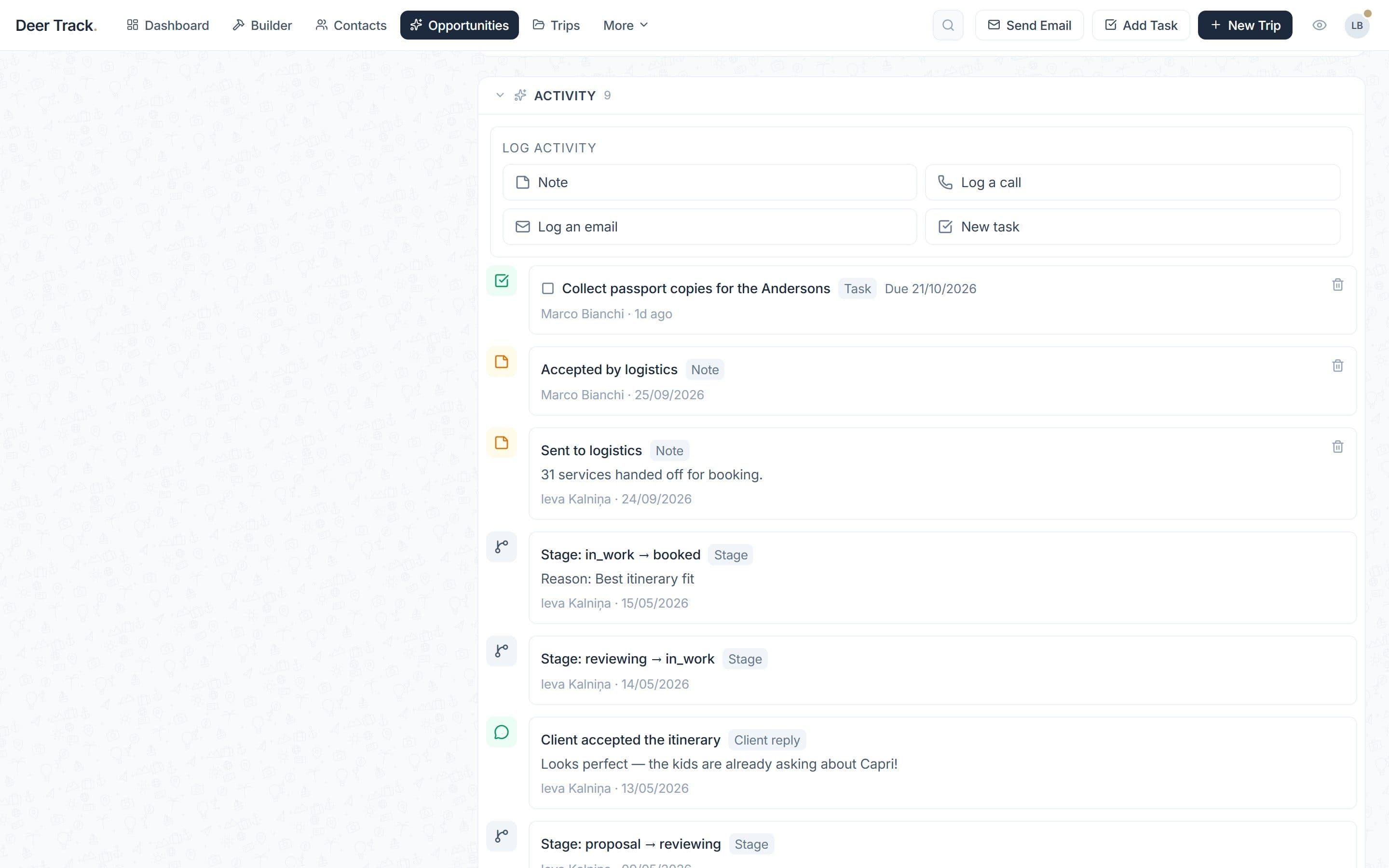
Running bookings from the trip itself
A shared spreadsheet with a row per service gets a small team a long way. It struggles with what lives outside the sheet: email threads, pending replies and due dates nobody looked at.
Frequently asked questions
What is supplier booking management in travel?
It is the process of taking every service in a sold trip, such as hotels, guides, transport, restaurants and tickets, from first request to written confirmation, payment and reconfirmation, while tracking deadlines, changes and correspondence for each one.
What should a booking request to a supplier include?
Your company and file reference, exact dates and times, numbers of travellers, rooms or tickets by type, the expected rate or contract, special requirements, and what you need back by when: availability, rate, option date, payment and cancellation terms.
What is the difference between an option date and a release date?
An option date is how long a supplier holds space for you before you must confirm or lose it. A release date, common in group contracts, is when rooms you have not filled or named go back to the hotel, after which changes may be charged or no longer guaranteed.
When should tour operators reconfirm supplier bookings?
Commonly in the last one to two weeks before arrival, in writing, checking dates, times, numbers, names, special requests and payment status. Many operators also make a final call to guides and drivers a day or two before the service.
When is a supplier booking actually confirmed?
When you hold a written confirmation from the supplier with a booking reference, the dates, the numbers and the agreed rate. A verbal yes or an unanswered request is not a confirmation.