
Tourplan alternatives: when you need a full DMC system, and when you don’t
Tourplan is a full reservation and accounting system for tour operators and DMCs. Here is who it suits, which alternatives are worth a look, and when a lighter tool is enough.
Key takeaways
- Tourplan is a full back-office system — product database, quoting, reservations, operations and integrated accounting — used by established inbound operators and DMCs.
- Its closest like-for-like alternatives are other full systems such as Lemax and Kaptio; Tourwriter and Ezus sit between a full back office and a light tool.
- Many smaller operators do not need a general ledger in their booking system — they need fast quotes, a proposal the client can accept, a deposit they can pay online, and supplier bookings tracked.
- Deer Track covers that lighter loop; it is not an accounting system, a GDS or a B2B distribution platform, so it does not replace Tourplan for a large DMC.
Tourplan has been selling software to tour operators since 1986 and describes itself as “the world’s leading software solution for tour operators and destination management companies”. Its website says it has 450 clients in 75 countries and offices in Africa, the Americas, Asia, Europe and the Pacific. In many inbound markets it is the system the established DMCs run on.
People search for “Tourplan alternatives” for two quite different reasons. Some run a large operation and want to compare Tourplan with other full reservation systems. Others are smaller teams who were told a DMC “needs” a system like Tourplan and want to know whether they really do. This guide covers both — what Tourplan does well, the realistic alternatives, and when staying put is the right call.
What Tourplan does well
Tourplan is a back-office system in the full sense: one database for the products you sell, the bookings you take and the money that moves between clients and suppliers. From its products page and FAQs:
- A flexible product databasethat, in Tourplan’s words, “can handle any travel product or package” — accommodation, tours, transfers, seat-in-coach packages and series tours.
- Quoting for FIT and groups, including add-ons, variations and prices for different group sizes within the same proposal.
- Groups and MICE — multiple itineraries and room and pax configurations inside a single booking file.
- Operations — automatic supplier communications when a booking is made or amended, and a resource module for assigning guides, vehicles and drivers.
- Integrated accounting — accounts payable, accounts receivable and general ledger, with travel-based revenue and cost recognition and automated accruals, plus management reporting.
- Distribution — a B2B website for agents to quote, book and pay online, an API, and web and XML channels. Online supplier connectivity gives access to accommodation, tours, activities and car rentals with dynamic rates.
- Deployment choice — a fully managed Tourplan Cloud (SaaS) or an on-premises installation on Windows Server and Microsoft SQL.
For an inbound operator selling to overseas wholesalers and agents, with an accounts team, a groups desk and an operations desk, that single database is the whole point. Bookings, supplier payables and revenue recognition stay in step without exports between systems.
Tourplan also sits at the centre of a wider ecosystem. Wetu, for example, advertises a Tourplan integration, so some operators keep Tourplan for costing and bookings and put a visual itinerary on top (see our Wetu alternatives guide).
Why operators compare Tourplan with other tools
- Scope versus team size. A system with general ledger, B2B distribution and resource scheduling needs set-up, training and someone who owns it internally. Tourplan says its implementations include training, mostly online and on-site as needed. For a team of three selling tailor-made trips direct, much of that scope goes unused.
- How it is priced.Tourplan’s FAQ says pricing depends on the edition and the number of concurrent users, billed as a monthly subscription for the cloud platform. That is a sensible model for a busy reservations team; a small operator will want to compare it with per-seat tools.
- The client-facing side.Tourplan’s own materials concentrate on reservations, operations and finance. Operators selling direct to travellers often want the proposal itself — design, photos, an accept button, a deposit link — to be the centre of the tool, or they add a presentation layer on top.
- Moments of change. A move from an older on-premises installation to the cloud, a merger, or a new market are natural points to check the options, even if the answer is to stay.
The Tourplan alternatives worth a look
Tourplan competitors fall into two groups. The first are full reservation and back-office systems — like-for-like replacements. The second are lighter tools that cover quoting, proposals and bookings but leave accounting to your accounting software.
Lemax
Best for: mid-to-large tour operators and DMCs, inbound and outbound, that want an integrated system for sales, operations and finance.
Strengths: a web-based platform with a reservation system, package builder and operations, finance and accounting, a CRM, workflow automation, supplier connections, a branded B2B portal and XML distribution to partners. Founded in 1990, it is a Croatian company headquartered in Zagreb.
Things to consider: it is the closest like-for-like alternative to Tourplan, which also means a similar implementation effort. Pricing is not published; it starts with a demo.
Kaptio
Best for: large multi-day tour, cruise, rail, group and tailor-made operators. The brands shown on its website include Tauck, Intrepid, Viking and Audley.
Strengths: a modular platform for planning, booking and operating multi-day travel; its Capterra listing describes it as an end-to-end reservation platform built on Salesforce. Kaptio Pay handles payments on the platform, and it has announced AI agents for travel operations.
Things to consider: being built on Salesforce is a strength if your business already runs on it and a consideration if it does not. Expect an implementation project; pricing is by enquiry.
Tourwriter
Best for: luxury and bespoke DMCs and inbound FIT operators.
Strengths: supplier rates with dated periods and blackouts, a net-plus-markup costing engine, pax-break group pricing, supplier booking requests, traveller payments through Stripe and accounting connections including Xero. WeTravel announced in September 2026 that it had acquired Tourwriter.
Things to consider: it is lighter than Tourplan on general ledger and B2B distribution, but still an annual commitment with onboarding. Full detail in our Tourwriter alternatives guide.
Ezus
Best for:DMCs, travel designers and agencies selling FIT, group and MICE trips who want to “run your DMC from request to invoice”, as its website puts it.
Strengths: an itinerary builder, budgeting with markups, VAT and multiple currencies, document automation, a CRM, a traveller area, a payment portal, supplier management and financial management. It says it is trusted by 600+ agencies in 70+ countries.
Things to consider:it is broad, so check in the demo how deep its finance features go against your accountant’s needs. Pricing is not shown on its homepage.
Deer Track
Best for: small-to-mid tour operators, DMCs and tailor-made agencies that sell direct or to a few partners and want to go from enquiry to a priced, paid proposal quickly.
Strengths: a drag-and-drop itinerary builder on your own service catalog, live pricing in markup or margin, a branded web itinerary and PDF the client can accept or request changes on, invoices with deposits and balances paid by Stripe Connect and a 0% platform fee, a logistics board for supplier bookings, and a light CRM.
Things to consider: it is not a back-office system. There is no general ledger, no accounts payable module, no B2B agent portal or XML distribution, and no GDS connection. Hotel rates come through RateHawk only. There is no self-serve trial — every plan starts with a guided demo.
Tourplan vs the alternatives at a glance
| Built mainly for | Accounting | B2B distribution | Getting started | |
|---|---|---|---|---|
| Tourplan | Inbound & outbound operators, DMCs — FIT, groups, MICE | Integrated AP, AR and general ledger | B2B website, API, web & XML | Demo; cloud or on-premises implementation |
| Lemax | Mid-to-large tour operators and DMCs | Finance and accounting module | B2B portal, XML | Demo; implementation |
| Kaptio | Large multi-day, cruise and rail operators | Built on Salesforce; payments module | Not confirmed | Enquiry; implementation |
| Tourwriter | Luxury & bespoke DMCs, inbound FIT | QuickBooks/MYOB export, Xero sync | Not found | Annual plans, onboarding package |
| Ezus | DMCs, travel designers, agencies | Financial management, payment portal | Not found | Demo |
| Deer Track | Small-to-mid operators, DMCs, tailor-made agencies | Not built — invoices and payments via Stripe Connect | No | Guided demo, migration help included |
And the two ends of the market, side by side:
| Tourplan | Deer Track | |
|---|---|---|
| Product data | Product database for any travel product or package | Your own service catalog — import from CSV or Excel |
| Quoting | FIT and group quotes, prices by group size in one proposal | Live pricing as you build; markup or margin; per person or flat rate |
| Group pricing | Groups and MICE modules, multiple room/pax configurations | Re-prices for any party size; Options A/B for the client to compare |
| Client proposal | Quotes and itineraries from the booking file | Branded web link + client PDF; accept or request changes, pay by invoice link |
| Client payments | B2B website with online payments | Stripe Connect, deposits and balances, 0% platform fee |
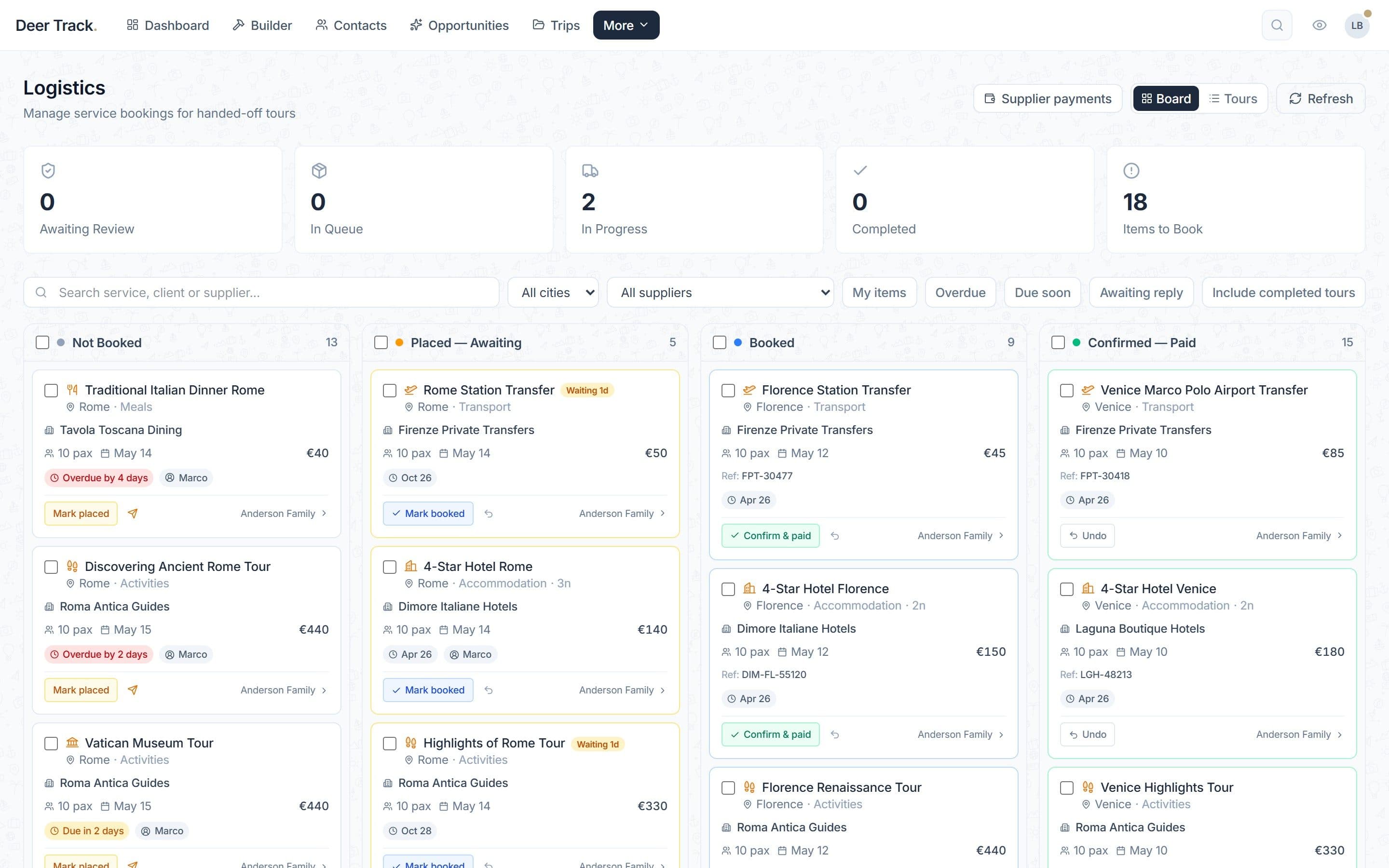
| Supplier bookings | Automatic supplier communications, amendments, cancellations | Logistics board: not booked → placed → booked → confirmed |
| Guides, vehicles, drivers | Resource assignment module | Not built |
| Accounting | AP, AR, general ledger, accruals, revenue recognition | Not built |
| Supplier connectivity | Accommodation, tours, activities, car rentals | Hotels via RateHawk |
| Deployment | Managed cloud or on-premises | Cloud only |
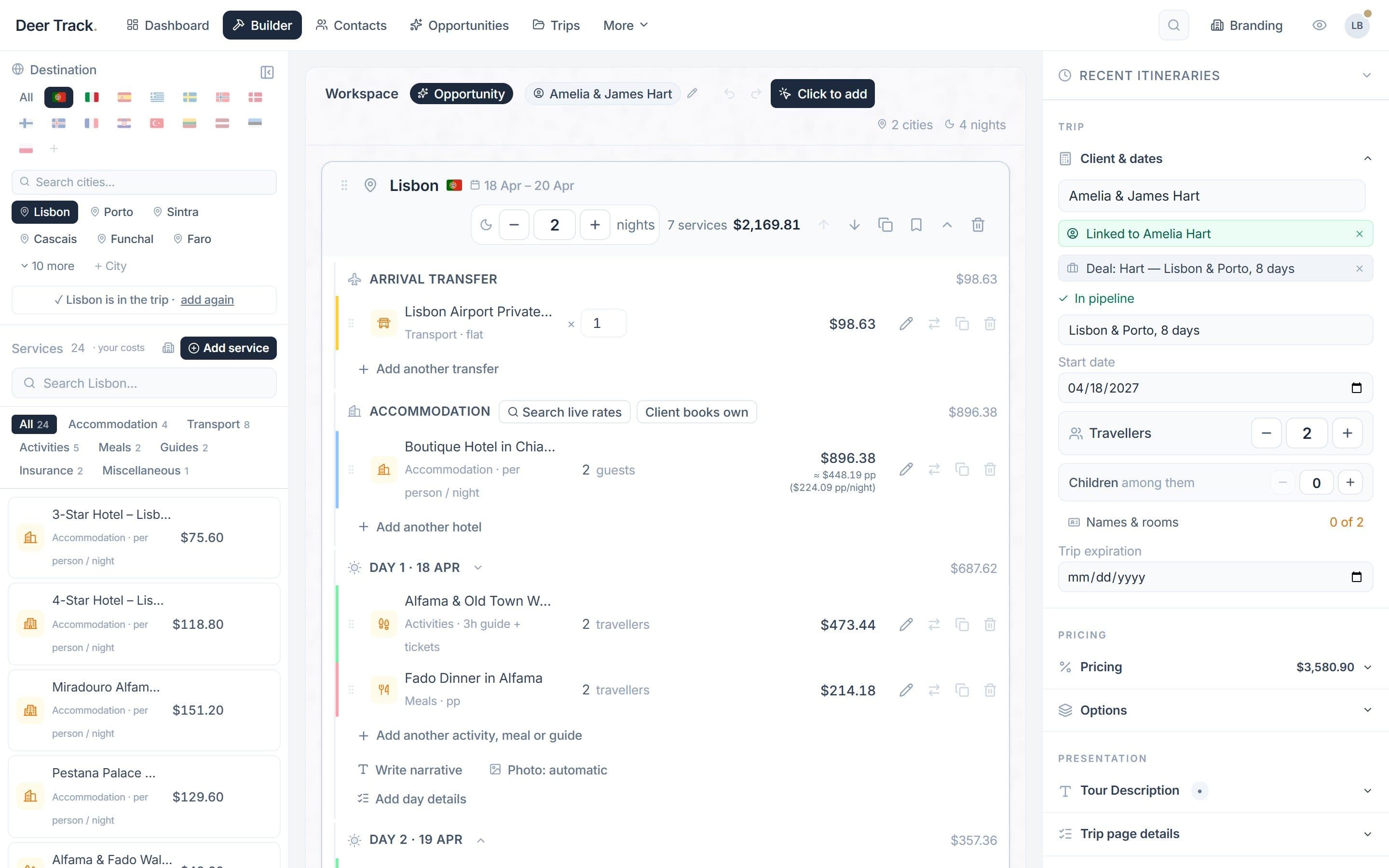
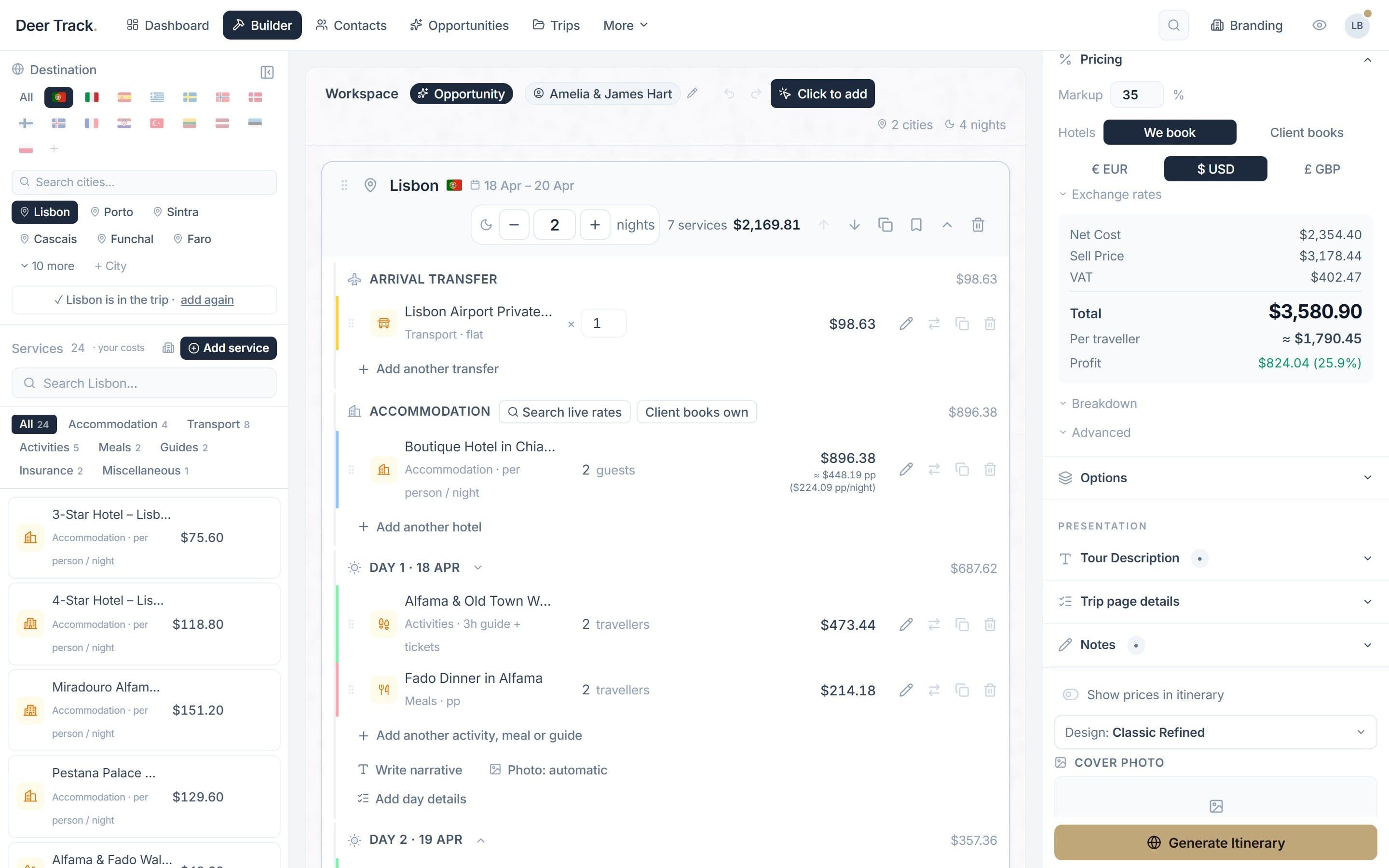
01One screen for the whole trip
Your own catalog on the left, the trip in the middle, and the client, pricing and presentation on the right.
- One screen for the whole trip: Your own catalog on the left, the trip in the middle, and the client, pricing and presentation on the right.
- Pick a city, see your services: Choose a country and a city and your services for it appear with your costs. Drag one onto the trip, or use Click to add.
- Each city is a block: Set the nights and the dates follow. The block shows how many services it holds and what they cost, as you build.
- A slot for every part of the stay: Arrival transfer, hotel, then each day's activities, meals and guides. Per-person lines price for the travellers; group lines are shared.
- Travellers drive the price: Change the number of travellers — or the children among them — and every per-person line re-prices on the spot.
- Know your margin before you send: Markup or margin, trip currency and exchange rates. Net cost, sell price, VAT, total, per traveller and profit update live.
- Choose the design and generate: Show or hide line prices, pick one of four designs and press Generate Itinerary — the branded client link is ready to share.
The honest summary: Tourplan runs the whole business, from product contracting to the general ledger. Deer Track runs the selling part — build, price, propose, get paid, book the suppliers — and leaves the books to your accounting software.
When to stay with Tourplan, and when to switch
Stay with Tourplan (or pick a full system) if…
- Agents and wholesalers book you through a B2B site or XML.
- Your accounts team works in the booking system: payables, accruals, revenue recognition.
- You run a groups or MICE desk with complex room and pax set-ups.
- You schedule your own guides, vehicles and drivers.
- Several departments share one database and it works today.
A lighter tool may fit better if…
- You sell tailor-made trips direct, or to a handful of partners.
- Your accountant already keeps the books in separate software.
- Speed of quote and the look of the proposal win you business.
- You want deposits paid from the proposal, not chased by email.
- Most of a full system's modules would go unused.
One middle path is common: keep Tourplan as the system of record and add a presentation layer on top. If that is where you are leaning, compare the visual tools in our Wetu alternatives guide. For the wider market, from advisors to enterprise systems, read the best itinerary builder software, and see all our comparisons on the alternatives page.
What to check in any DMC reservation system
Whichever shortlist you end up with, ask every vendor to show — not describe — these on your own data:
- Rates as you contract them — seasons, room types, per person versus per room, child and single rates.
- A group re-price — change a quote from 2 to 6 travellers and check that rooms, vehicles and per-person tickets each follow their own rule.
- Margin you can see — net, sell and profit per line and per trip, in markup or margin terms.
- The client’s view — open the proposal on a phone. Can the client understand it and say yes from it?
- Deposits and balances — how the client pays, where the money lands, and what the platform charges.
- Supplier bookings — how a confirmed trip turns into supplier requests, and how you see what is still unconfirmed.
- Amendments — change a date after booking and see what updates automatically.
- Accounting hand-off — what your accountant receives, in what format, and how often.
- Distribution — only if agents or wholesalers book you online: B2B site, API or XML.
- Time to first quote — how long from signing to your team quoting live enquiries, and who does the data set-up.
The last two separate the full systems from the lighter tools more than any feature list. If distribution and accounting matter, you are buying a back office. If they do not, you are buying a quoting and selling tool, and should judge it on speed.
How to test an alternative without disrupting operations
- Pick two trips you sold last season — one simple FIT, one group — with their real supplier costs and the price you charged.
- Rebuild both in the tool you are evaluating. Time it, and check the per-person price against what you charged.
- Send the proposal to yourself, open it on your phone, and try to accept it and pay a deposit invoice as the client would.
- Ask your accountant what they would need from the new tool each month, and check the tool can give it to them.
- If you switch, quote new enquiries in the new tool and let sold trips finish where they are. Running both for a season is normal.
Frequently asked questions
What is the best Tourplan alternative?
For a like-for-like back-office system, look at Lemax, or Kaptio if you are a large multi-day operator already on Salesforce. For luxury FIT DMCs, Tourwriter. For small-to-mid operators who need quoting, proposals, payments and supplier bookings but not a general ledger, Ezus or Deer Track. Large inbound DMCs with B2B distribution and accounting in the system are often best served by Tourplan itself.
What is a DMC reservation system?
It is software that holds a destination management company's products and supplier rates, turns quotes into bookings, sends supplier requests and tracks payments. Full systems such as Tourplan and Lemax also include accounting and B2B distribution to agents and wholesalers.
Is Tourplan cloud-based?
Tourplan offers both. Its website lists a fully managed Tourplan Cloud (SaaS) and an on-premises option that runs on Microsoft Windows Server and Microsoft SQL, as of October 2026.
Can Deer Track replace Tourplan?
For a small-to-mid operator that uses Tourplan mainly to quote, book suppliers and invoice clients, it can cover that loop. It cannot replace Tourplan's integrated accounting, B2B agent website, XML distribution or resource scheduling, so a large DMC that relies on those should stay with a full system.
Does Deer Track have accounting like Tourplan?
No. Deer Track invoices clients with deposits and balances and takes payments through Stripe Connect with a 0% platform fee, but it has no general ledger or accounts payable module. Your bookkeeping stays in your accounting software.
How long does it take to move off Tourplan?
Most of the work is product and supplier data. Export it to a spreadsheet, import it into the new tool, rebuild your best-selling trips as templates, and quote new enquiries in the new tool while sold trips finish in Tourplan. Check with your accountant how historic financial data will be kept.