
AI itinerary generators for tour operators: what they can and can't do (and how to use one without losing your margin)
AI can turn a messy client enquiry into a first-draft tour in seconds. It can also invent a hotel and quietly eat your margin. Here is where it helps, where it doesn't, and a workflow that keeps you in control.
Key takeaways
- AI is excellent at reading a messy enquiry and drafting a route, nights per city and day-by-day text — the slow, blank-page part of quoting.
- A general chatbot does not know your suppliers, your contracted rates or today's availability, so it will happily suggest things you cannot sell.
- The AI should choose what goes into a trip; your rates and pricing rules should decide what it costs — never the other way round.
- The quality of an AI draft depends on your supplier catalog: clean, well-described services in, usable drafts out.
- Keep a human check before anything reaches the client: route logic, every line, the total and the words.
Every tour operator has tried it by now: paste a client’s email into a chatbot, ask for a ten-day itinerary, and get back something that reads beautifully. Then the real work starts. Half the hotels are not ones you contract with, one closed last year, the drive on day four is twice as long as it looks, and there is no price — or worse, a price that bears no relation to your costs.
None of that means AI is useless for quoting. It means it is good at a specific part of the job and dangerous at another. This guide separates the two, shows with real arithmetic what happens when AI touches your pricing, and sets out a workflow — and a set of questions for software vendors — that lets you quote faster without handing your margin to a language model. We run tour companies in the Baltics ourselves, and we built AI drafting into our own software, so this is written from both sides of the table.
Two very different things called an “AI itinerary generator”
The phrase covers two kinds of tool that behave very differently in a working travel business.
1. General chatbots and consumer trip planners
These generate an itinerary from what the model learned on the public internet. They are built for travellers planning their own holiday. They know that Lisbon has a castle and Porto has port cellars; they do not know which hotel in Alfama gives you a net rate, which guide you trust on a Sunday, or what you paid for a minibus last season. Their output is text: you read it, then retype it into whatever you use to cost and send a quote.
2. Catalog-grounded generators inside tour software
These work from yourdata. The AI reads the client’s enquiry and builds a trip using only the hotels, transfers, guides and activities already in your supplier catalog. The output is not a paragraph but a structured trip — cities, nights, services per day — that your software can price with your own rules and turn into a client proposal.
General chatbot
- Suggests any hotel or tour it has read about
- No idea of your contracted rates
- Guesses a price, or leaves it out
- Output is text to copy and retype
- No link to booking or payment
Catalog-grounded generator
- Picks only services you already sell
- Priced from your own rates
- Pricing rules, not the AI, set the total
- Output is an editable trip
- Flows on to the proposal, booking and invoice
Both are useful. A chatbot is a fine research assistant when you are designing a new product or writing destination copy. But when a client enquiry arrives and you need a quote out today, the second kind is what saves real time — because its output is something you can actually sell.
Where AI genuinely helps a tour operator
The slow part of quoting is rarely the arithmetic. It is getting from a vague, chatty email to a first structure you can react to. That is exactly where language models are strong.
- Reading messy enquiries.“Two couples, late May, love food and old towns, nothing too rushed, comfortable but not flashy” contains a party size, a season, a pace, a budget tier and interests. AI pulls those out reliably, even when they are scattered across three paragraphs and a signature.
- A first route and nights per city. Given ten days and three destinations, a sensible split and order is something AI drafts well — and something you can correct in seconds if it is wrong.
- Filling the days. Matching the stated interests to activities you already offer, so the food lovers get the market tour and the cooking class rather than three museums.
- The words. A trip title, a short description and a paragraph per day are slow to write well and quick for AI to draft. You edit; you do not start from a blank page.
- Flagging gaps.A good tool tells you what the client asked for that your catalog cannot serve — “they want a vineyard lunch and you have none in that region” — instead of inventing one.
Put together, that is the first draft of a quote: the part that used to take the longest. If you want the full picture of where the rest of the time goes, our guide to quoting faster, from enquiry to proposal walks through each step.
Where it fails — and why that matters more in travel
Language models produce text that sounds right. In most industries a confident mistake is embarrassing; in travel it can strand a client or lose you money. The failure modes to plan for:
- Invented or outdated suppliers. A hotel that closed, changed its name, or never existed in that street. A general chatbot has no way of knowing.
- Prices. Any figure a general model gives you is a guess from old public information. It is not your net rate, it ignores seasons and group size, and it knows nothing of your markup.
- Availability and operating days. AI cannot see that the museum is shut on Mondays this year or that the hotel is full for a conference that week. Only a supplier can confirm that.
- Distances and pace. Drive times that look short on a map can be long on real roads; a day with a border crossing and two visits may simply not fit.
- Terms and legal wording. Cancellation terms, package-travel information and payment conditions are yours to write and check. They are not something to accept from a draft.
Why AI must never set your price: a worked example
The quiet danger is not a ridiculous price — you would spot that. It is a plausible one that is slightly off, on a line you did not re-check. Here is how a small error becomes a big margin problem.
Worked example: one wrong hotel rate
A seven-night trip for four travellers in two double rooms. You price on a 20% margin. Your planned net cost is €4,000, so the selling price is:
Planned profit: €5,000 − €4,000 = €1,000.
But the hotel rate in the draft came from a chatbot, and it is €25 per room per night below your actual contracted rate. Across two rooms and seven nights that is:
Real net cost: €4,000 + €350 = €4,350. The client has already accepted €5,000, so your profit is €5,000 − €4,350 = €650 — a margin of €650 ÷ €5,000 = 13%, not 20%. One line, one plausible-looking number, and over a third of the profit on the trip is gone.
The fix is structural, not “be more careful”: the AI should never produce a price at all. It should choose services, and every service should carry its rate from your catalog, so the total is calculated the same way as a trip you build by hand — with your seasons, group size, VAT and markup or margin applied by rules you control. If you want to check the maths on your own trips, the free tour price calculator and our guide to markup vs margin show exactly how the selling price follows from cost.
Your AI is only as good as your supplier catalog
A catalog-grounded generator can only pick from what you have entered. If your catalog has three hotels in Lisbon and none in Porto, no amount of clever AI will produce a good Porto stay. Before you judge any AI drafting tool, spend an afternoon on the catalog it will draw from:
- Cover your core routes. For every destination you sell often, at least one hotel per budget tier you sell, the transfers between cities, and your staple guides and activities.
- Name and describe services clearly.“Food market walking tour, 3 hours, small group” is something AI can match to “they love food”. “Tour B” is not.
- Put the city on everything. The AI needs to know where a service happens to place it on the right day.
- Keep rates current. Seasonal rates and group prices entered once mean every draft is priced correctly, not just the ones you remember to fix.
- Retire what you no longer sell. A closed restaurant left in the catalog is a closed restaurant in your next draft.
This work pays off twice: it makes manual quoting faster too. Our service library guide shows how we structure a catalog, and importing your data covers bringing an existing supplier spreadsheet across in one go.
A safe AI-assisted quoting workflow
This is the order we recommend, whichever tool you use. The AI does the first two minutes; you keep every decision that costs or earns money.
Paste the enquiry as it arrived
Do not rewrite it into a form. The client’s own words carry the pace, tone and priorities. Add one line of your own if something important is missing (for example the budget tier you already agreed on the phone).
Read the route before the details
Check the order of cities, the nights in each, and the travel days. A wrong route makes every line below it wrong, so fix it first.
Go line by line
Hotel right for this client? Transfer the right size for the party? Activity on a day it actually runs? Swap anything that does not fit — it is a normal trip now.
Let your pricing rules set the total
Set the number of travellers, your markup or margin and any discount. Then look at the profit line, not just the total.
Edit the words in your voice
AI day descriptions are a starting point. Remove anything you cannot promise (“breathtaking views from every room”) and add the local detail only you know.
Confirm with suppliers before you promise
Availability is never the AI’s call. Send the proposal as a quote, and confirm with suppliers as the client moves towards yes.
Beyond the screen: bots and AI agents that draft tours
The next step for many teams is not a better button in the app but drafting from wherever the enquiry already is — a shared inbox, a team chat, a website form, or an AI agent that triages incoming requests. That needs an API: one request in with the brief, one draft trip out, saved in your system for a person to review.
If you go down this route, insist on three things:
- Draft only. The API should create drafts, not publish to clients, change prices or book suppliers.
- Narrow keys. A key used by a bot should not be able to read your contacts, your rates or your settings — if it leaks, the damage is limited to someone drafting trips.
- Revocable. You should be able to switch a key off in one click.
Handled this way, automation does not remove the human check — it just means the draft is waiting for your team when they open the enquiry.
Questions to ask any AI tour builder vendor
Demos of AI features are easy to make impressive. These questions get past the demo to what will happen with your data and your margin:
- Does the AI choose only from my own suppliers, or can it add things that are not in my catalog?
- What happens to a suggestion it cannot match — is it dropped and reported, or quietly kept?
- Who sets the price: the AI, or my rates and pricing rules?
- Can anything reach a client without a person on my team publishing it?
- Which AI model runs it, whose account pays for it, and can I cap the monthly spend?
- What data is sent to the AI provider — only my catalog, or also client contacts and invoices?
- Is the result an editable trip in the same tool I price, send and invoice from?
- Is there an API, and what exactly can its keys do?
Run every vendor through one of your own recent enquiries, with your own suppliers loaded, rather than their demo data. If you are comparing tools more broadly, our itinerary builder software comparison covers the wider field.
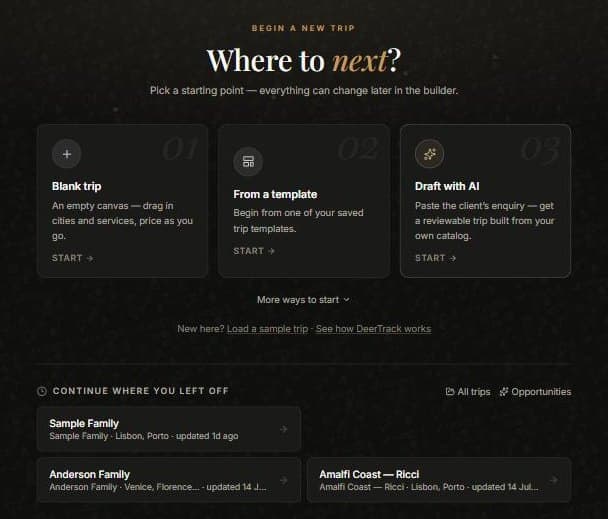
Frequently asked questions
What is an AI itinerary generator?
An AI itinerary generator turns a travel request into a draft itinerary: route, nights per destination, activities and day-by-day text. Tools for tour operators work best when the AI builds the draft from the operator's own supplier catalog, so the result can be priced and sold.
Can I use ChatGPT or another chatbot to build tour itineraries?
You can use a general chatbot for ideas and destination copy, but it does not know your suppliers, contracted rates or availability. Treat its output as research, and build the sellable quote from your own suppliers and pricing.
Should AI set the price of a tour?
No. Let AI choose which services go into a trip, and let your own rates, markup or margin, seasons, group size and VAT rules calculate the price. A plausible but wrong AI price on one line can remove a large share of the profit on a trip.
Will AI replace tour operators and travel designers?
Not on its own. AI speeds up the first draft, but supplier knowledge, availability, pricing judgement, local detail and the client relationship remain human work. Operators who use AI for drafting can quote faster without giving those up.
How do I get better results from an AI tour builder?
Keep your supplier catalog complete and clearly described, with cities and current rates on every service, and give the AI full enquiries that include dates, party size, pace, budget tier and interests. Then review route, lines, price and wording before sending.